RAG: A System Design Perspective (Not a Buzzword)
Stop treating Retrieval-Augmented Generation (RAG) as a prompt engineering trick. From a system design standpoint, RAG is a distributed data pipeline problem wrapped in an LLM interface. It is an architectural pattern designed to solve three specific engineering constraints: context window limits, data freshness, and hallucination reduction by grounding generation in external truth.
If you are designing a RAG system, you are not just building a chatbot; you are building a search engine with a generative frontend.
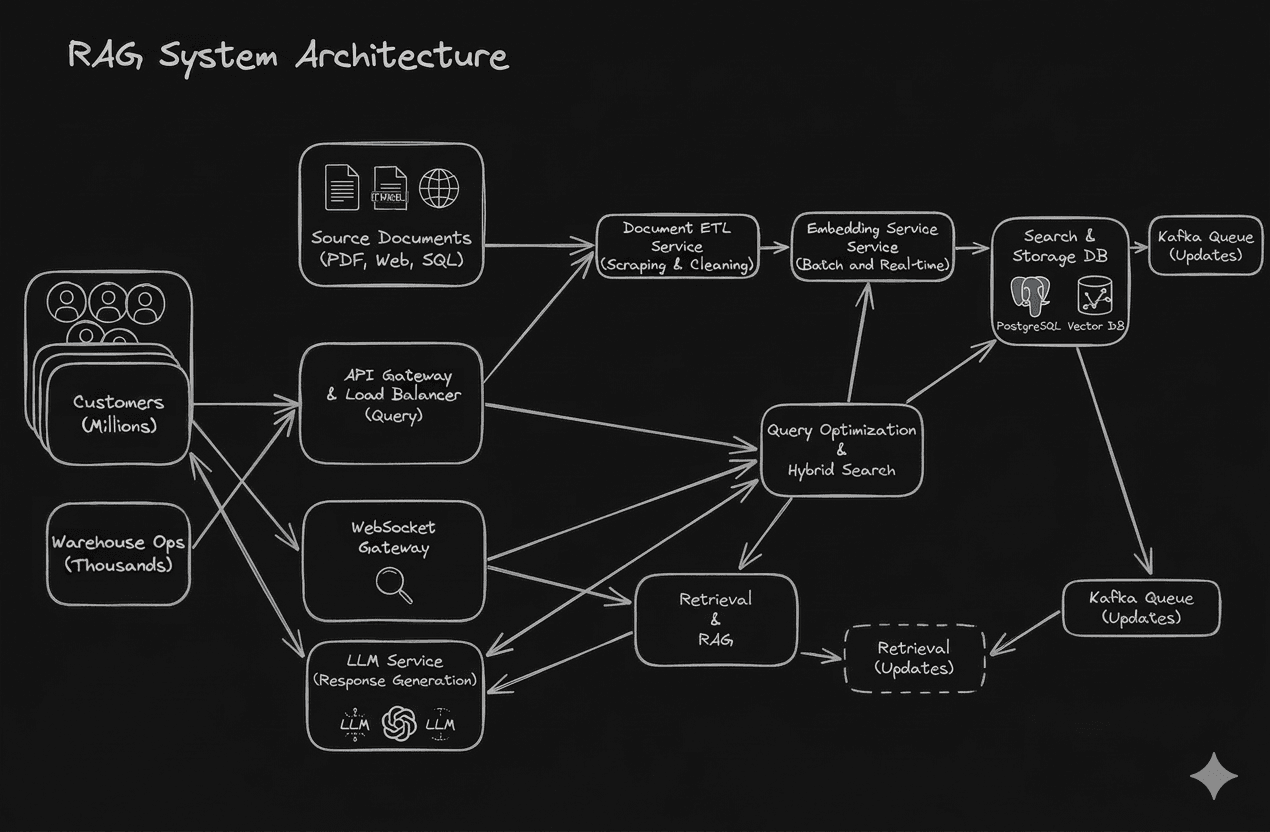
The High-Level Architecture
A production-grade RAG system consists of two distinct, decoupled pipelines: the Ingestion Pipeline (write-heavy, async) and the Query Pipeline (read-heavy, low-latency).
[Data Sources] → [ETL/Chunking] → [Embedding Model] → [Vector DB]
                                            ↑
[User Query] → [Query Embedding] → [Retrieval] → [LLM Context] → [Response]
1. The Ingestion Pipeline (The Hard Part)
Most engineers focus on the query path, but the system's reliability depends on the ingestion pipeline. This is an asynchronous ETL process.
- Chunking Strategy: This is effectively data sharding. You must decide on chunk size (tokens) and overlap. Too small, and you lose semantic context; too large, and you waste context window tokens on irrelevant noise.
- Embedding Generation: This is a compute-intensive batch job. You cannot embed documents on the fly during the query path without incurring massive latency. These must be pre-computed and stored.
- Data Consistency: What happens when a source document updates? You need a CDC (Change Data Capture) mechanism to invalidate old vector embeddings and re-index the new chunks. Without this, your system serves stale "truth."
2. The Query Pipeline (Latency Optimization)
The user-facing path has a strict latency budget (usually <2 seconds).
- Hybrid Search: Relying solely on vector similarity (k-NN) often fails on exact keyword matches (e.g., product IDs). A robust system combines Dense Retrieval (vectors) with Sparse Retrieval (BM25/keyword) and merges results.
- Re-Ranking: Initial retrieval fetches top-k (e.g., 20) documents. A cross-encoder re-ranker then scores these 20 for relevance before passing the top-5 to the LLM. This adds latency but drastically improves precision.
- Context Window Management: You are paying for every token sent to the LLM. The retrieval layer must filter aggressively to minimize cost and latency.
Key Design Trade-offs
| Component | Decision | Trade-off |
|---|---|---|
| Vector DB | Managed (Pinecone) vs. Self-hosted (Milvus/pgvector) | Ops Overhead vs. Cost/Control. Managed scales easier; self-hosted offers data sovereignty. |
| Chunk Size | Small (256 tokens) vs. Large (1024 tokens) | Precision vs. Context. Small chunks retrieve precise facts; large chunks provide better narrative flow. |
| Retrieval | Top-K Fixed vs. Dynamic Threshold | Recall vs. Noise. Fixed K is simpler; dynamic threshold prevents feeding irrelevant docs to the LLM when no good match exists. |
Failure Modes & Monitoring
A System Designer must plan for failure. RAG systems fail silently.
- Retrieval Failure: The relevant doc exists but wasn't retrieved. Mitigation: Monitor "Recall@K" metrics using a golden dataset.
- Generation Failure: The LLM ignores the context. Mitigation: Use prompt constraints and evaluate output faithfulness.
- Latency Spikes: Embedding APIs or Vector DBs can throttle. Mitigation: Implement caching for frequent queries and circuit breakers for external embedding calls.
Conclusion
RAG is not magic; it is Search + Summarization. By treating it as a data engineering challenge—focusing on indexing strategies, consistency models, and latency budgets—you move beyond the hype and build systems that are reliable, scalable, and maintainable.
The key insight is treating RAG as a distributed systems problem, not an AI prompt trick—engineering rigor over hype.