Behind the Scenes of Ride Booking: A System Design Deep Dive
Ever wondered what happens when you tap "Book Ride"? Let's explore the distributed architecture powering modern ride-hailing platforms like Uber and Rapido.
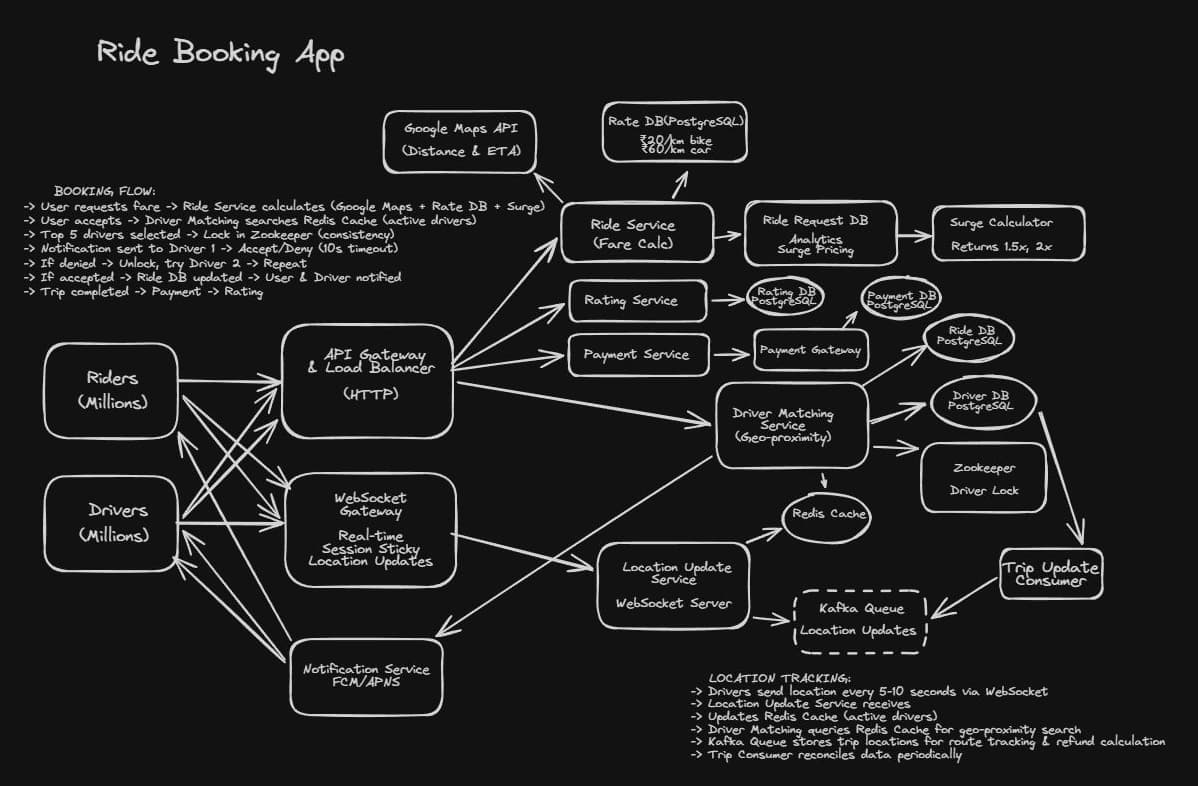
Request Flow Architecture
Rider App → API Gateway → Load Balancer → Microservices Cluster
                ↓
         Kafka Event Stream → Driver Matching → Redis Cache
                ↓
         WebSocket Gateway → Real-time Location Updates
When you request a ride, your app hits the API Gateway, which authenticates and routes requests to appropriate microservices. The Fare Estimation Service calculates pricing by querying Google Maps API for distance/ETA and applying rate cards from PostgreSQL, including dynamic surge multipliers during high demand.
Core Service Interactions
| Service | Responsibility | Tech Stack | SLA |
|---|---|---|---|
| Driver Matching | Geo-proximity search | Redis GeoSpatial + ZooKeeper | <100ms |
| Location Tracking | Real-time GPS streaming | WebSocket + Kafka | <2s latency |
| Trip Dispatch | Driver assignment logic | Flink Stream Processing | <60s |
| Payment Service | Transaction processing | PostgreSQL + Payment Gateway | Idempotent |
| Notification | Push alerts | FCM/APNS + WebSocket | <1s |
The Critical Matching Flow
When you book, the Driver Matching Service executes a complex workflow:
- Query Redis for available drivers within 5km using
GEORADIUScommand - Rank drivers by proximity, ratings, and acceptance rate
- Acquire distributed lock via ZooKeeper to prevent double-booking
- Send ride offer to top 3 drivers sequentially (10s timeout each)
- Update state in PostgreSQL upon acceptance
Interactive Element: Visualize a live architecture diagram where you can click each service to see current metrics: active drivers in your zone, average matching time, Kafka throughput (events/sec), and Redis cache hit ratio.
Real-Time Location Pipeline
Drivers send GPS coordinates every 5-10 seconds via WebSocket. The Location Update Service ingests these into Kafka, where stream processors update:
- Redis geospatial index (for matching)
- PostgreSQL trip history (for audit)
- Rider's app via WebSocket broadcast
CAP Theorem Trade-offs
The system prioritizes Availability for fare estimation and tracking (eventual consistency acceptable) but enforces Strong Consistency for driver assignment using distributed locks—preventing the catastrophic scenario of double-booking a driver.
This architecture handles millions of concurrent users while maintaining sub-minute assignment latency through strategic caching, partitioning, and asynchronous event-driven design.
The beauty of ride-booking systems lies in their elegant balance between consistency and performance, between user experience and infrastructure constraints.